Claude Code cost
Claude Code cost depends on how you pay. On Pro, Max or Ultra you pay a flat plan price and are not billed per token. With an API key you pay the list price for every token. Drop your .claude/projects folder below to see what your work costs, or would cost, on the API.
By The Pacewick team (Product and testing). Last updated .
.claude/projects folder hereHow to work out your Claude Code cost, step by step
- Open the projects folder inside .claude in your home folder (on Windows it is %USERPROFILE%\.claude\projects).
- Drag the folder onto the drop zone above, or press Choose folder and pick it.
- Read the cost per day chart to spot the days that cost the most.
- Next, open the model table to see which model takes the largest share of the price.
- Then check the project table to find the repo that spends the most.
- If you pay by API key, compare the daily figure with the averages from Anthropic below.
The dashboard is free and runs in your browser. The first 3 CSV reports each day are free too; see the pricing page for more, or read how we test the tool.
Claude Code cost tested with a real input
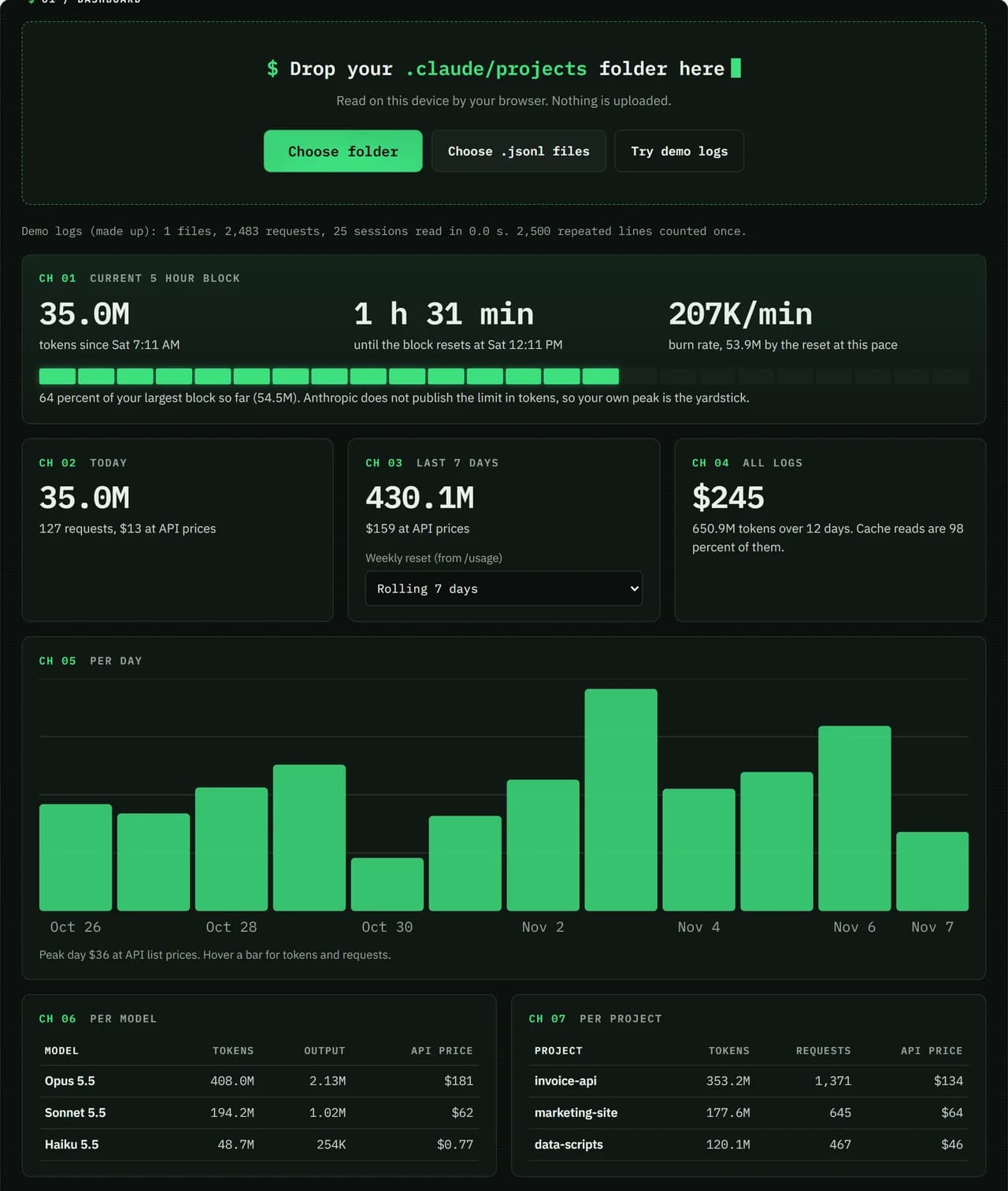
We ran our made up demo log through this exact dashboard. The numbers come from the same run, so you can compare them with your own logs.
- Test input
- Demo log: 12 days, 3 made up projects, 7,466 lines
- Output
- Dashboard on the demo log
- Requests counted
- 2,483
- Repeated lines skipped
- 2,500
- Total tokens
- 650.9M
- Cache reads
- 97.7 percent
- API list price
- $244.63
- 5 hour blocks
- 24
- Log size
- 3.2 MB
- Parse time
- 35 ms
How we test: every page uses the same demo log, and we check each total by hand. More on the about page.
How the Claude Code cost is calculated
First, each answer in your logs lists its input, output, cache write and cache read tokens. The dashboard multiplies each type by the list price of the model that produced it. Then it adds the five parts together. Fast mode on Opus 5 and Opus 5.5 is priced at twice the normal rate.
Cache writes, on the other hand, come in two kinds. A 5 minute write costs 1.25 times the input rate, while a 1 hour write costs twice the input rate. Cache reads are the cheapest part, about a tenth of the input rate on most models. The price table on this page lists the exact rates.
A worked example from the demo log
The demo log on this site covers 3 projects over 14 days with three models: Opus 5.5, Sonnet 5.5 and Haiku 5.5. Also, it holds 2,483 requests and 651 million tokens in total. At API list prices that comes to $244.63, or about $17.47 a day.
That price is low for 651 million tokens, and the split explains why. In fact, 97.7 percent of those tokens are cache reads, which cost $0.20 per million on Opus 5.5. The rest of the bill comes from input, output and cache writes.
Subscription or API: which price applies to you
Pro, Max and Ultra plans are not billed per token. Instead, your use counts against a 5 hour limit and a weekly limit, shared with claude.ai. On those plans, read the dollar figure as what the same work would cost through the API.
However, there is one catch to check. If the ANTHROPIC_API_KEY environment variable is set, Claude Code uses that key instead of your plan. Then every token is billed at API rates. So if you expected to use your subscription, make sure the variable is not set.
What teams spend on average
Anthropic gives a few averages for enterprise use. A developer costs about $13 per active day and $150 to $250 per month. Also, 90 percent of users stay under $30 per active day.
As a result, these numbers help you judge your own figure. If your daily price is far above them, open the model table first. A cheaper model for routine work lowers the price of every token, as the table shows. Note that /usage and the status line also show prices at list rates.
API list prices per 1 million tokens (checked November 7, 2026)
| Model | Input / output / cache write 5m / 1h / cache read |
|---|---|
| Fable 5.1 | $10 / $50 / $12.50 / $20 / $0.25 |
| Opus 5.5 | $4 / $20 / $5 / $8 / $0.20 |
| Opus 5 and Opus 4.5 to 4.8 | $5 / $25 / $6.25 / $10 / $0.50 |
| Sonnet 5.5 and Sonnet 5 | $2 / $10 / $2.50 / $4 / $0.20 |
| Haiku 5.5 | $0.10 / $0.50 / $0.125 / $0.20 / $0.01 |
Claude Code cost FAQ
How much does Claude Code cost per month?
On a plan you pay the plan price. For teams on the API, Anthropic puts the enterprise average at $150 to $250 per developer per month.
Does /usage show my Claude Code cost?
Yes, for API users. The Session block in /usage shows tokens and cost at list price. On a plan, /usage shows your limit bars instead.
Why does my Claude Code cost look so high on a Max plan?
The figure is the API list price of your work, not your bill. Max is not billed per token, so you only pay the plan price.
Does Claude Code charge my API key or my subscription?
Your subscription, unless ANTHROPIC_API_KEY is set. With that variable set, Claude Code bills the key at API rates.
Which model is cheapest in Claude Code?
Haiku 5.5 has the lowest list price in the table, at $0.10 per million input tokens and $0.50 per million output tokens.